

Share this
by Wealthstone Group on Sep 01, 2026
The Market’s Wishlist Is Not The Fed’s Agenda
“Yeah... That’s not going to happen.” – Phil, The Hangover (2009)
Executive Summary
-
Labor market, softening but steady: July payrolls fell by 23,000, yet the unemployment rate slipped to 4.1% as workers left the labor force, leaving the picture cooler but not cracked.
-
The Fed, less talk and no cut on offer: Chair Kevin Warsh held rates at 3.50% to 3.75% on a divided 9-3 vote, kept forward guidance minimal, and framed a hike, not a cut, as the live question.
-
The long end, still climbing: The 30-year Treasury pushed above 5.25% intraday and the 10-year touched a roughly 20-month high in August on term premium, supply, and fiscal concerns.
-
Iran, a standoff rather than an ending: The conflict has settled into a cold-war rhythm of sanctions and retaliation that keeps a risk premium in oil and an inflationary tilt in the backdrop.
- Crowding out: AI financing and government borrowing are competing for the same pool of capital, pushing rates higher for consumers and businesses that had nothing to do with either.
- Portfolio takeaway: In our view this environment rewards diversification, deliberate duration, and a long horizon over positioning for a pivot that keeps not arriving.
Performance
Through 8/25/2026, the equity tape stayed constructive even as leadership rotated hard. The S&P 500 gained 4.39% over the past month and sits at 13.77% YTD, but the style gap is the real headline: Russell 1000 Value has returned 24.57% YTD while Russell 1000 Growth has managed just 5.12%. International has kept pace, with MSCI EM up 24.57% and MSCI EAFE up 14.44% YTD. Sector leadership tells the same rotation story: Energy leads at 40.39% YTD, followed by Materials (18.02%) and Info Tech (24.12), while Utilities (2.54%), Communication Services (0.23%), and Consumer Discretionary (-0.95%) bring up the rear. Fixed income is still fighting the long end: the U.S. Aggregate is flat at 0.11% YTD, Treasuries off 0.16%, and corporates barely negative at -0.01%, while short TIPS (+0.76%) and municipals (+0.58%) squeezed out gains. A tape where value, energy, and short duration lead is a tape that has stopped waiting for rate cuts, which is where the Fed comes in.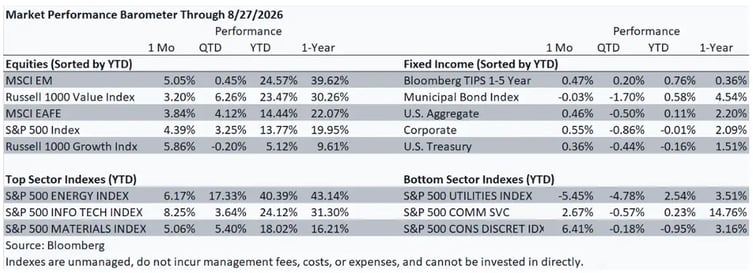
Still Standing at Last Call
The July employment report was the kind of print that reads better in the headline than in the fine print. The unemployment rate eased to 4.1% from 4.2%, but partly for the wrong reason: the labor force shrank and participation fell to its lowest level since early 2021. Payrolls contracted by 23,000, dragged down by local government education and retail even as private payrolls eked out a small gain, and revisions lopped a combined 103,000 off May and June. Wage growth cooled to 3.2% year over year, the slowest since May 2021. This is a labor market holding its footing rather than expanding, cooling through fewer workers rather than mass layoffs. For portfolios, a jobs backdrop that is soft but orderly argues for staying invested in quality cyclicals while respecting that consumer-facing earnings may face a slower top line.
The Fed Orders a Round of Silence
Warsh continued the house style he introduced this spring: say less, promise less, and let the data do the talking. The July statement again omitted forward guidance, and the Committee held at 3.50% to 3.75% on a 9-3 vote, with the dissents leaning toward a hike, the most hawkish split in the same direction in years. Warsh has been direct that rates “could well be part of” the answer to sticky inflation and that the target is 2 percent, full stop. The through-line is a central bank that is wait-and-see by design and increasingly attentive to upside inflation risk rather than to easing. Investors have spent much of this cycle penciling in the next cutting campaign, and the Fed keeps answering that request the way Phil would. Futures now price essentially no cuts for 2026, and September is a hold-versus-hike conversation, not a hold-versus-cut one. For portfolios, we would not build around a pivot the policymaker keeps declining to endorse; a barbell of quality duration and short-duration exposure looks more durable than a rate-cut bet.
The Long End Keeps Its Tab Open
While the front end waits on the Fed, the back end has been writing its own story. Term premium, heavy issuance, and fiscal anxiety have pushed long yields up even as short rates sit still, with the 30-year above 5.25% intraday in August and the 10-year probing a roughly 20-month high. Treasury’s expanded buyback plans offered only a brief reprieve before yields firmed again. A steeper curve driven by the long end, rather than by cuts at the front, changes the math on everything from mortgages to equity discount rates, and it is a big part of why the Bloomberg Aggregate is underwater on the year. For portfolios, it reinforces the case for spreading interest-rate exposure across the curve rather than reaching for yield at the very long end, where price swings have been unforgiving.
The Standoff in the Gulf
The conflict with Iran has not ended so much as changed shape. What began as open hostilities has settled into something closer to a standoff: rounds of sanctions, strikes and counterstrikes, and rhetoric that moves headlines more than front lines. Markets periodically price in hopes of a negotiated end, then reprice the end back out. Two channels matter for portfolios. First, sanctions and disrupted tanker traffic keep a persistent risk premium in oil, which helps explain Energy’s 42.96% YTD run at the top of the sector table. Second, sustained military spending is fiscal stimulus with an inflationary tilt, arriving at exactly the moment the Fed is trying to finish the inflation fight. Neither channel calls for a portfolio reaction to each headline. Both reinforce the Fed’s reluctance to ease.
Too Many Hands on One Tab
Beneath the rate story sits a supply-and-demand problem in the capital markets themselves. The AI buildout is no longer funded from cash flow alone: data centers, chips, and the power to run them are increasingly financed in the debt markets, and that borrowing now lands on top of historically large government deficits. When two of the biggest borrowers in the world, the technology complex and the U.S. Treasury, compete for the same pool of savings, the price of money rises for everyone standing behind them in line. Mortgages, non-AI business loans, and consumer credit are all priced off a curve being pushed higher by borrowing that has nothing to do with the household or the shop on Main Street. This is classic crowding out, and it suggests the elevated cost of capital is a feature of this cycle rather than a blip. For portfolios, it favors businesses that can self-fund their growth, argues for selectivity in credit where leverage is building fastest, and adds one more reason the long end may stay stubborn even if the economy cools.
Know Your Limits
The recurring lesson of 2026 is that the market’s wish list and the Fed’s to-do list are not the same document, and building a portfolio around the gap between them is a good way to get surprised. Value, energy, and international have carried the tape, bonds have struggled, and the long end has reminded everyone that duration cuts both ways. Rather than wager on when the cut everyone keeps requesting finally lands, the more reliable edge is the unglamorous one: diversify across regions, styles, and asset classes, keep duration deliberate, and let a multi-year horizon absorb the noise. When the next headline promises the pivot is imminent, remember how the Fed has answered so far this year. Discipline, not prediction, remains the play.
Louis Tucci; Partner | Senior Investment Advisor
Paulo Aguilar, CFA, CAIA; Partner | Senior Investment Advisor
Mark H. Tucker, CFA; Chief Investment Officer
Mason King; Portfolio Manager
Securities offered through Arkadios Capital. Member FINRA/SIPC. Advisory services through Arkadios Wealth.
Past performance does not guarantee or is indicative of future results. This summary of statistics, price, and quotes has been obtained from sources believed to be reliable but is not necessarily complete and cannot be guaranteed. All securities may lose value, may not be insured by any federal agency and are subject to availability and price changes. Market risk is a consideration if sold prior to maturity. Information and opinions herein are for general informational use only and subject to change without notice.
This material does not constitute an offer to sell, solicitation of an offer to buy, recommendation to buy, or representation as the suitability or appropriateness of any security, financial product or instrument, unless explicitly stated as such. This information should not be construed as legal, regulatory, tax, personalized investment, or accounting advice.
The information is current only as of the date of this communication and we do not undertake to update or revise such information following such date. To the extent that any securities or their issuers are included in this communication, we do not undertake to provide any information about such securities or their issuers in the future. The views expressed reflect the author(s) personal view and not the view of Arkadios Capital or Arkadios Wealth. This report is provided on a “where is, as is” basis, and we expressly disclaim any liability for any losses or other consequences of any person’s use of or reliance on the information contained in this communication.